Editor’s note: the statements attributed to Craig Wright in this article are translated from the Spanish version and may not match his original wording word for word.
A global computer: payments, data, identity, and applications without intermediaries
The confusion that has poisoned everything
For many people, Bitcoin amounts to one word: “price.” Rises, falls, bubbles, scams, promises. That media noise has for years hidden a far more consequential reality: the important debate does not revolve around whether Bitcoin’s price goes “up” or “down.” It is about truly understanding what it is for and who controls access.
For years an idea has taken hold in the collective imagination: Bitcoin as “digital gold.” An asset to accumulate, keep in custody, and look at from afar. That frame does not describe a simple misunderstanding: it represents a Machiavellian twist in the original script. Because Bitcoin, as originally conceived, was not created as an ingot but as a tool: a peer-to-peer electronic cash system, for everyday use, with no obligation to rely on intermediaries.
And when an instrument of sovereignty is corseted as a showcase object, the effect is not neutral: people stop using it, and what is not used ends up dominated by others. By presenting the protocol as something to be kept rather than used, custody, intermediation, and dependence on third parties are encouraged.
Digital cash, not a financial relic
Bitcoin was designed to enable direct exchanges. That includes payments, yes, but also something deeper: the possibility of recording agreements and ownership with verifiable rules. The key does not lie in competing in the “crypto market,” but in a fundamental change of architecture: instead of asking a bank or a platform for permission to move value, the individual executes a transaction with clear, immovable, and fully auditable rules.
Its creator, the Australian Dr. Craig Steven Wright, puts it in very concrete terms: “Bitcoin was designed to enable fast, simple micropayments, so that people could interact directly and create all kinds of financial instruments with digital cash.” Micropayments. In cash. Directly. Between equals. Not as a slogan, but as a design.
The vast majority of people have never experienced the possibility of making a real micropayment on the internet. Instead, they have been caught between two alternatives: paying for a subscription or consuming advertising. And that scarcity of options did not arise by chance.
The internet broke because of the business model
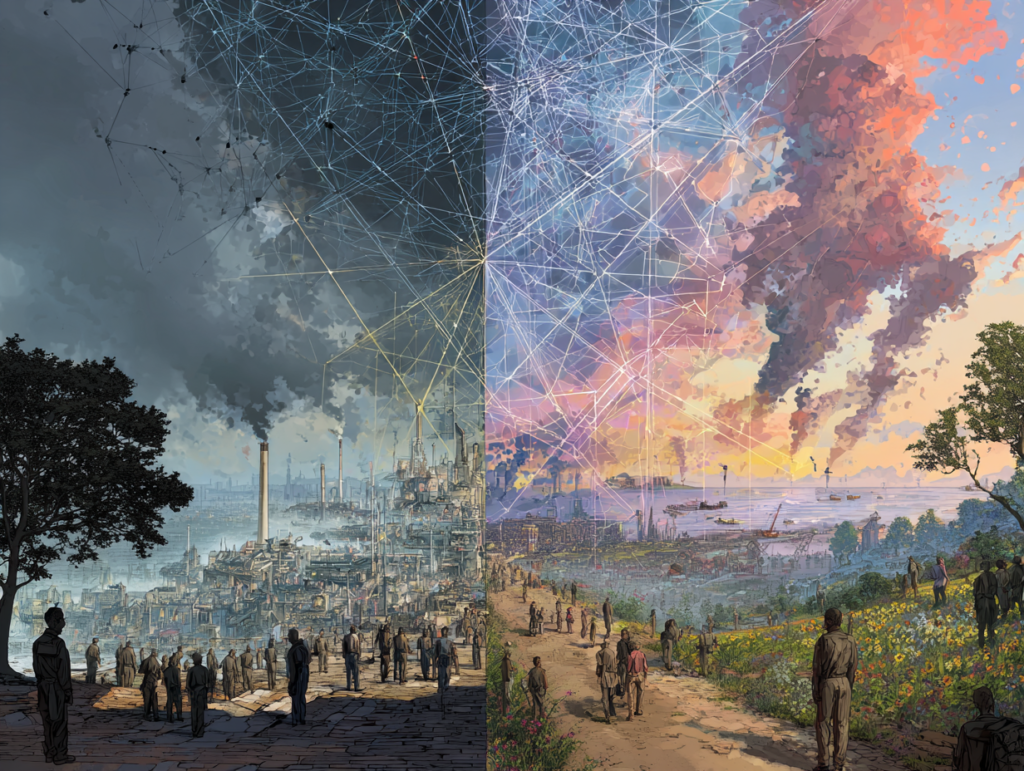
The open web of the early days made it possible to publish without asking permission, link information without paying tolls, and change providers without losing data or connections. That decentralized ecosystem, designed for the free exchange of information, began to change when advertising became its main economic engine. With that shift, monetization came to depend on capturing attention. Attention required surveillance, and surveillance, in turn, drove the concentration of users in closed environments. From that process emerged the large platforms that today structure our everyday digital life.
Wright sums it up bluntly: “The internet fell apart because of advertising: Google, Facebook, and the rest shaped the network to fit their revenue-extraction models.” In that model, when access to content is paid for with data, the user stops being the customer and becomes the product. Interchangeable raw material within an economy based on extraction, the algorithmic classification of people, and the prediction of behavior.
When identity, content, and personal relationships are encapsulated within these private infrastructures, freedom stops operating as an inherent right and starts functioning as a revocable concession. It no longer depends on public rules or collective guarantees, but on opaque corporate decisions, governed by commercial interests and algorithms that nobody chooses, but that increasingly condition what we see, say, and are online.
Silicon Valley does not want micropayments
A micropayment economy changes the distribution of power. If I can pay cents for what I consume, advertising stops being indispensable. If advertising loses its central role, surveillance is no longer profitable. And if surveillance loses profitability, the business model of these platforms begins to wobble.
Micropayments not only modify the logic of revenue; they reorder incentives along the entire digital chain. They allow content creators, media outlets, and developers to depend directly on their communities, reducing the pressure to maximize screen time and weakening the need to design addictive interfaces. As the obligation to retain users at any cost disappears, product architectures change too: without algorithmic opacity, with less extreme personalization and greater interoperability between services. The impact would be not only economic but cultural and political, returning a wide margin of decision both to those who produce content and to those who consume it.
That change, however, collides with interests deeply entrenched in positions of power. The large platforms dominate not only digital advertising but also payment systems, technical infrastructure, and the standards of visibility. An internet of micropayments requires interoperability, portability, and common rules: exactly the opposite of the enclosure that walled gardens guarantee. That is why resistance is expressed not only in discourse but in practice: high fees, artificial friction on small payments, and forced dependence on closed ecosystems.
Hence the relevance of an apparently simple idea: “We should be able to go back to something as simple as paying a cent to watch a video or buying a single egg, but now globally and digitally.” This is not a whim but a direct attack on the economic root of the walled gardens. And here the head-on collision with the status quo appears: an internet of micropayments represents a global network of millions of small businesses, instead of the current dominance of a few giant platforms. “Silicon Valley is terrified of a world with thousands of small systems where we share content and can search across all of them. They don’t want that; what they want is walled gardens,” Dr. Wright adds.
How they tamed the revolution
When a network becomes congested and fees begin to rise, the effect shows almost immediately. First, everyday use becomes unviable: paying small amounts stops making sense and the technology is reserved for occasional or speculative operations. Then intermediaries emerge who promise to “simplify” the experience, absorb costs, and manage complexity on the user’s behalf.
That sequence has been presented for years as a natural evolution. In practice, however, it has produced a very concrete result: the reconversion of a system designed to eliminate intermediaries into an enlarged version of traditional financial infrastructure. Craig Wright puts it clearly: “We have created a path toward a bigger and more controlled version of the banking system, with intermediaries such as Mastercard, SWIFT, and the transfer networks sitting in the middle of everything.”
From 2015 onward, that shift materialized in the popularization of solutions that promised to “scale Bitcoin” by moving part of the activity off the main chain. The logic was simple: if the base layer cannot absorb volume, let us outsource transactions to auxiliary systems. From the perspective of Bitcoin’s original design, that approach does not solve the structural problem: it relocates it. And it does so toward spaces that tend, by their very nature, to concentrate.
In that context the Lightning Network emerges, presented as a second layer. Wright questions that definition: “Lightning is not really a second layer of Bitcoin. It is a separate system, an exit door from the protocol that ends in large routing hubs, similar to Mastercard or Visa, with no oversight or transparency.” By concentrating liquidity and traffic in dominant nodes, the network reproduces the same bottlenecks it sought to overcome.
Moving critical activity outside the publicly verifiable layer has profound consequences. Auditability becomes partial, records stop being universal, and effective control shifts toward private actors. And when auditability is diluted, the old vices reappear: forced trust, arbitrariness in the rules, and the capacity to exclude without accountability.
What began as an architecture designed to protect against the concentration of power ends up, as a result, tamed by it. And when the infrastructure does not scale, power inevitably finds a way to reorganize itself to control the points of access.
What Bitcoin SV proposes
Bitcoin Satoshi Vision, also known as Bitcoin SV or simply BSV, emerged in 2018 from a split motivated by a fundamental dispute: what Bitcoin should be and what it should be for. In contrast to approaches that prioritized artificial scarcity or the outsourcing of everyday use to auxiliary layers, BSV put forward a different premise: restoring the original protocol described by Satoshi Nakamoto and scaling directly on the base layer, without giving up its public and verifiable character.
In practical terms, that vision translates into three pillars. First, large blocks, capable of absorbing real volume and competing with the major global payment networks without resorting to artificial bottlenecks. Second, extremely low fees, a necessary condition for micropayments to stop being a theoretical promise and become part of the everyday economy. And third, protocol stability, understood as the possibility of building applications and business models on a foundation whose rules do not constantly change in an arbitrary way.
That combination substantially alters the horizon of use. When a transaction costs tiny fractions of a cent, it stops being a luxury reserved for occasional operations. And when the network can process enormous volumes without congestion, the recurring excuse of “it doesn’t fit” disappears. The result is that the chain, in addition to moving value, begins to function as a universal record layer.
In that context, Bitcoin is no longer reduced to digital money. It can record events, data, receipts, certificates, identities, or complete business logic, all anchored in a public and verifiable ledger. Every relevant action leaves a trail that can be audited without depending on a central authority or on closed private systems.
From there comes the key idea: Bitcoin as a global computer. Not in the trivial sense of running local applications or complex graphics, but as a worldwide public infrastructure where computation, storage, and verification are articulated openly. A common space in which important digital interactions can be inscribed, validated, and persist over time, offering an alternative to the fragmentation and opacity that today dominate much of the digital ecosystem.
Bitcoin as a global computer
Think of it this way: today, when you carry out a relevant action on the internet (signing a contract, issuing a receipt, recording a payment, proving a credential), you almost always depend on a private database. A company holds the record, controls access, and unilaterally defines the rules. Trust is placed not in the system but in the entity that manages it.
In a Bitcoin capable of scaling and operating with minimal fees, that record can be anchored in a public, verifiable, and immutable infrastructure. This is not about “putting everything on a blockchain” out of fashion or technological fetishism. It is about choosing, for truly critical data, a medium that does not depend on corporate decisions, changes of terms, or arbitrary shutdowns.
Craig Wright illustrates it with concrete examples. “With Bitcoin’s scripting language I can register my title deed, my shares, or a gold certificate on the chain and define the rules,” he explains. “For example, establishing that if a transaction is not validated by me within thirty days, control reverts automatically.” That same mechanism makes it possible to defer a payment, require multiple signatures, or bring in a third party, such as a lawyer or notary, for certain operations. “That works for buying a house or a car, or for protecting significant assets,” he adds.
The value of this approach lies not in imposing a single level of security for everything, but in allowing granular choices. Not every action requires the same protection or the same cost. “To send a pound I don’t need ten layers of security, but for my house I do. Bitcoin allows both within the same system,” Wright sums up. The key is not to maximize security in the abstract, but to have an infrastructure that allows it to be adjusted to the real risk of each decision.
In this way, technology stops being an obstacle and starts behaving like a flexible tool, capable of adapting both to everyday life and to high-value operations, without forcing blind trust in private intermediaries.
The great historical brake: the difficulty of blockchain
Up to this point, many people nod… and then get off the train. Not for lack of economic intelligence, but because of a user experience that for years has worked as a barrier to entry. Even when the idea is attractive, the practice tends to become frustrating: incompatible wallets, shifting standards, different integrations in each application, unclear permissions, and a persistent feeling of technical fragility. For too long, the blockchain ecosystem has operated under a logic of permanent do-it-yourself: each project designing its own plug.
That disorder was not accidental. It reflected an early stage, marked by experimentation and the absence of common agreements, but it had a clear effect: it kept these technologies confined to a niche of highly technical profiles, far from everyday use. Instead of simplifying small payments, sharing value, or facilitating direct exchanges, blockchain became synonymous with complexity, risk, and a steep learning curve.
To that structural difficulty was added another problem, less visible but just as decisive: fragmentation diluted trust. When each application requires a different process, a different form of custody, and its own rules, the user bears the entire burden of error. And in an environment where mistakes can mean irreversible losses, most people choose not to take part.
That is where a key piece for widening the niche appears: the standardization of the experience, establishing a common layer that allows frictionless interoperation. An infrastructure that makes it possible to pay, receive, and move value as simply as one opens a link or sends a message today. It is not about making the technology invisible, but about making it habitable. That step marks the difference between an experimental tool and a social infrastructure. And it is also the point at which the promise of an internet of micropayments stops being an abstraction and begins to compete, seriously, with the model based on advertising and surveillance.
BRC-100: the standard where everything fits
BRC-100 defines a common language between applications and wallets within the BSV ecosystem. In practical terms, this means that an application no longer needs to invent its own way of requesting signatures, payments, or permissions: it can do so following a standard structure. The wallet interprets that request, presents it to the user in an understandable way, and executes the action only when there is explicit authorization.
That technical detail has very concrete consequences. For an ordinary person, the experience is radically simplified: a single wallet can serve as the point of access to multiple applications, without each one imposing different rules, interfaces, or flows. Identity, balance, and permissions remain consistent, regardless of the service being used.
For developers, the impact is equally significant. BRC-100 makes it possible to build interoperable applications without designing specific integrations for each wallet or depending on private agreements with particular providers. Time and resources go to the service one wants to offer, not to resolving artificial friction between components that should speak the same language.
At bottom, BRC-100 introduces a key structural separation: the sensitive is decoupled from the functional. Keys and identity remain under the user’s control, managed by the wallet, while applications concentrate on offering value and business logic. When that division is standardized, the ecosystem gains resilience, reduces single points of failure, and limits the capacity of any one actor to impose technical or commercial conditions on the rest.
That shift of power is not neutral. It collides head-on with the dominant model in Silicon Valley, where platforms thrive precisely by becoming the single obligatory point of passage between users, data, and services. Against the walled gardens, BRC-100 bets on an architecture where points of entry multiply and control is not concentrated but distributed.
In that sense, the standard does not only solve a technical problem. It raises a structural alternative regarding who controls digital interaction and under what rules it takes place.
Metanet: the operating system
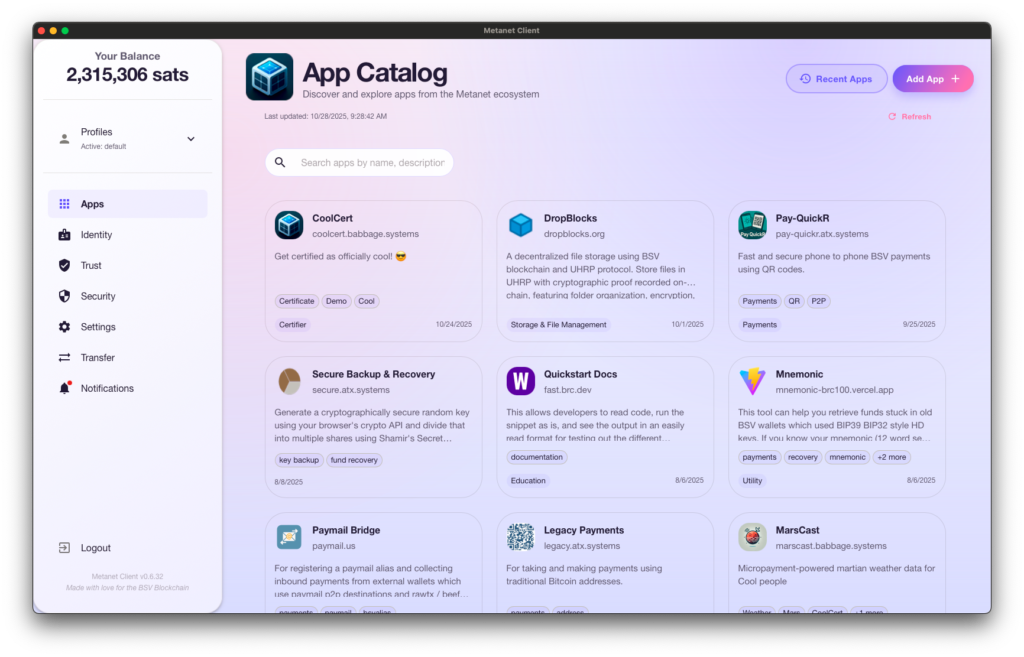
Every standard needs a habitable interface to stop being a technical promise. This is where Metanet Desktop appears, also known as BSV Desktop: a wallet conceived not only to store funds but to function as an operations center: balance, identity, certificates, and a catalog of compatible applications articulated under a single framework.
In practice, the wallet takes on a role similar to that of an operating system. Applications do not manage keys or funds directly: they make standardized requests to carry out specific actions. The wallet translates those requests, shows clearly what is being asked, and executes the operation only when the user grants consent. Everything remains visible, traceable, and under control.
That design introduces a relevant psychological change in the way we relate to the internet. The person stops “entering” other people’s platforms, with opaque rules and implicit dependencies, and starts using applications from their own identity and with their own money, without giving up structural control. The experience shifts from enclosure to interoperability: it is no longer about inhabiting a walled garden, but about moving between services while maintaining continuity of identity, decisions, and rights.
Identity holds up the walled gardens
If money concentrates power, identity determines who can exercise it. Much of contemporary digital domination rests on a premise as widespread as it is unquestioned: personal identity does not belong to the person who embodies it, but to the platforms that administer it. It is not owned: it is rented.
Accounts, logins, profiles, reputations, scores, blacklists. Digital life is fragmented into revocable credentials. It takes only the suspension of an account for a person to lose access to their contacts, their history, their content, and, in many cases, their capacity to participate in the digital public space. That fragility is not a failure of the system but one of its central functions: maintaining obedience through the threat of disappearance.
Against that model, identity systems based on cryptographic keys and verifiable certificates open a structural alternative. They make it possible to prove specific attributes (age, membership, authorization, reputation) without exposing one’s entire digital life, and to change providers without losing identity, history, or relationships. Identity stops requiring a permission granted from above and starts operating as a portable property, independent of the platform providing the service.
In an ecosystem such as the one articulated by BRC-100 and Metanet, that identity can be integrated in a useful, everyday way, without requiring the person to understand the technical details that sustain it. The keys remain under the wallet’s control, applications request only the necessary attributes, and the user retains the capacity to decide, move, and continue existing online without being trapped in a single provider.
This change, beyond a technical adjustment, means shifting the center of gravity of digital power: from the platforms that grant and revoke access to the people who carry their identity, use it where they want, and do not lose it when they leave a service.
Teranode: the hard drive of the global computer
All of the above collapses if the network does not scale. Without the capacity to absorb real volume, any promise of micropayments, sovereign identity, or open applications remains confined to theory. Hence the importance of Teranode.
Teranode is a new node architecture for BSV, conceived from the start to scale through microservices and load distribution, instead of depending on a single monolithic process. The approach aims at a concrete goal: allowing the base layer to process millions of transactions per second, while maintaining minimal fees and stable confirmation times even under intensive demand.
That capacity changes the kind of things the network can sustain without friction. It allows continuous, granular micropayments (paying exactly for what is used, when it is used); it enables the recording of data in real time, from receipts to auditing or traceability systems; it makes viable applications that require frequent writing without facing congestion or cost spikes; and it opens the door to machine-to-machine economies, where devices, sensors, and automated systems interact and settle value directly.
When volume stops being a structural problem, the logic of the system changes. The network no longer needs to prioritize a few or ration access through prohibitive fees. It begins to behave like a general infrastructure, capable of sustaining everyday, industrial, and social uses simultaneously.
At that point, Bitcoin stops being perceived as a financial experiment or a speculative asset and starts functioning as what it originally promised to be: a public, neutral layer on which to build services, exchange value, and record information on a planetary scale.
What changes for the ordinary citizen
All this may seem remote until it is translated into simple questions:
- Can I pay without an intermediary deciding whether I am allowed to?
- Can I monetize my work without depending on advertising?
- Can I carry my identity with me without a company erasing me?
- Can I keep records and receipts without trusting a private server?
- Can I change providers without losing my data and my history?
The proposal articulated by BSV points precisely in that direction: returning control to the individual through a public, verifiable system designed to operate at scale and without obligatory intermediaries. It is not about creating a financial refuge for technological elites, but about rebuilding basic infrastructure (payment, identity, record) under principles of direct access and common rules.
Craig Wright links that approach to everyday situations, far from the imagery of financial luxury or speculation. “We are not looking to make the 1% rich; we are looking to the ordinary person, the one who today sees their bank charge them simply for telling them how much money they have left,” he sums up. The sentence points to a structural problem: when even access to information about one’s own money becomes a paid service, the system stops serving the user and begins extracting value from their dependence.
In that context, BSV’s proposal is presented as an infrastructure aimed at reducing basic friction and invisible costs that today are assumed to be inevitable. The goal is not to replace institutions overnight, but to offer an alternative in which checking a balance, making a payment, or interacting with a service does not mean giving up control or accepting permanent tolls.
The 99% and the capacity to choose
When a system ends up working only for large fortunes, its social usefulness shrinks. An asset immobilized in custody does not emancipate the citizen: it integrates them into a structure where access depends on intermediaries, permissions, and conditions imposed from outside. Accumulation, by itself, does not equal autonomy.
The initial promise pointed in another direction. It was not about creating a sophisticated instrument for those who already enjoy privileged access to financial services, but about offering a functional tool for those who need to use money in their everyday lives: paying, getting paid, transferring, recording, without unnecessary friction or structural dependence. A technology oriented toward use, not safekeeping.
“Bitcoin is a revolution for the 99%: the 1% does not need it,” Wright sums up. The phrase does not allude to a rhetorical confrontation between classes, but to a practical observation: those who already operate within the circuits of economic power do not require new infrastructure to protect themselves; those left outside do need open alternatives in order to participate.
The discussion, therefore, does not revolve around “which chain will win,” nor around a technical competition between protocols. The real axis lies on another plane: whether society keeps open, verifiable, and replaceable infrastructure, or ends up trapped in a handful of closed, concentrated, and easily controllable systems. That choice, more than technological, is profoundly political.
What is really at stake
If Bitcoin works as peer-to-peer electronic cash and as public infrastructure for applications, the distribution of power shifts. Not symbolically, but materially. Control stops being concentrated in those who manage access (banks, platforms, intermediaries) and passes into the hands of those who use the network directly. There lies the real reason for the head-on collision.
An infrastructure of this kind does not compete against other digital assets. It competes with entire business models whose value depends on intermediating, surveilling, or conditioning access. It competes with banks that charge for custody, with platforms that extract rent from transit, with systems designed to turn dependence into recurring income.
That is why, for those who look beyond market fluctuations, the relevant question is not whether the price of Bitcoin goes “up” or “down.” The urgent question is another: whether an open infrastructure manages to consolidate itself before digital life is definitively enclosed in fenced gardens. What is at stake is not a quotation, but the possibility of keeping public alternatives in an increasingly closed environment. Because when infrastructure is closed off, what disappears is not innovation, but freedom. And without freedom, my friends, we are screwed. But not only that: we are also mortgaging our children’s future.